A lot of people think productivity means constantly doing more.
More tasks. More hours. More hustle. More pressure.
But many highly “productive” people are actually exhausted, distracted, overwhelmed, and mentally drained most of the time.
Real productivity is not about being busy every second of the day.
It is about using your time, energy, and attention more intentionally so important things actually get finished without destroying your mental health in the process.
That distinction matters because modern productivity advice often pushes unrealistic routines:
- Waking up at 4 AM
- Working nonstop for 12 hours
- Following complicated systems
- Treating rest like laziness
- Turning every hobby into “self-improvement”
Eventually, people burn out trying to optimize every minute of life.
The truth is that sustainable productivity usually comes from simpler habits repeated consistently.
This guide explains practical productivity habits that improve focus, organization, consistency, and mental clarity without turning life into constant pressure.
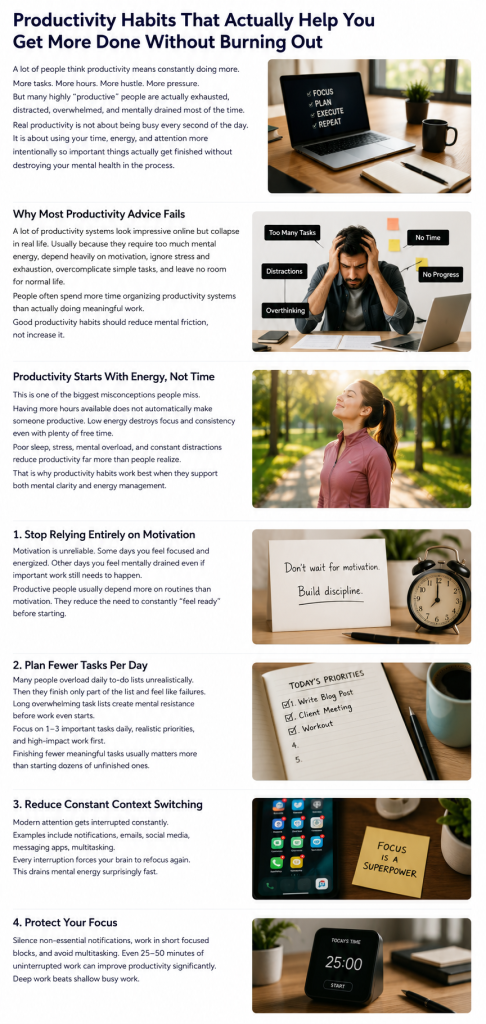
Why Most Productivity Advice Fails
A lot of productivity systems look impressive online but collapse in real life.
Usually because they:
- Require too much mental energy
- Depend heavily on motivation
- Ignore stress and exhaustion
- Overcomplicate simple tasks
- Leave no room for normal life
People often spend more time organizing productivity systems than actually doing meaningful work.
Good productivity habits should reduce mental friction, not increase it.
Productivity Starts With Energy, Not Time
This is one of the biggest misconceptions people miss.
Having more hours available does not automatically make someone productive.
Low energy destroys focus and consistency even with plenty of free time.
Poor sleep, stress, mental overload, and constant distractions reduce productivity far more than people realize.
That is why productivity habits work best when they support both mental clarity and energy management.
The Most Effective Productivity Habits Are Usually Simple
Complicated systems are harder to maintain consistently.
Simple habits often work better long term because they require less mental effort.
1. Stop Relying Entirely on Motivation
Motivation is unreliable.
Some days people feel focused and energized. Other days they feel mentally drained even if important work still needs to happen.
Productive people usually depend more on routines than motivation.
They reduce the need to constantly “feel ready” before starting.
Helpful Example
Instead of:
- “I will work when I feel motivated.”
a better system becomes:
- “I start working at this time regardless of mood.”
This reduces procrastination dramatically over time.
2. Plan Fewer Tasks Per Day
Many people overload daily to-do lists unrealistically.
Then they finish only part of the list and feel like failures.
Long overwhelming task lists create mental resistance before work even starts.
Better Productivity Strategy
Focus on:
- 1–3 important tasks daily
- Realistic priorities
- High-impact work first
Finishing fewer meaningful tasks usually matters more than starting dozens of unfinished ones.
3. Reduce Constant Context Switching
Modern attention gets interrupted constantly.
Examples include:
- Notifications
- Emails
- Social media
- Messaging apps
- Multitasking
Every interruption forces the brain to refocus again.
This drains mental energy surprisingly fast.
Ways to Protect Focus
Silence Non-Essential Notifications
Many notifications are not urgent at all.
Work in Short Focused Blocks
Even 25–50 minutes of uninterrupted work can improve productivity significantly.
Avoid Multitasking
Most people are not truly multitasking.
They are rapidly switching attention, which reduces efficiency and increases mistakes.
Why Environment Affects Productivity
Environment quietly influences focus more than people expect.
A cluttered, distracting space increases mental friction.
This does not mean you need a perfect minimalist office.
But small improvements help.
Helpful Workspace Habits
- Keep important tools nearby
- Reduce unnecessary clutter
- Use comfortable lighting
- Separate work and relaxation spaces if possible
The easier it feels to start working, the more consistent productivity becomes.
Sleep Is a Productivity Habit
Many people sacrifice sleep trying to become more productive.
Ironically, poor sleep often destroys focus, memory, decision-making, and efficiency.
Sleep deprivation reduces productivity even if someone spends more hours awake.
Signs Poor Sleep Is Hurting Productivity
- Brain fog
- Forgetfulness
- Difficulty focusing
- Constant procrastination
- Mental exhaustion
Good sleep improves productivity far more than many “hustle” strategies.
4. Start Before You Feel Fully Ready
Waiting for the “perfect moment” often becomes procrastination.
Many tasks feel mentally difficult before starting but become easier once momentum builds.
The beginning is usually the hardest part.
Helpful Trick
Commit to only 5–10 minutes initially.
Starting reduces mental resistance significantly.
5. Use Simple Systems Instead of Complicated Ones
People often build huge productivity systems that become exhausting to maintain.
Simple systems usually last longer.
Examples of Simple Productivity Systems
| Habit | Purpose |
|---|---|
| Daily task list | Prioritize work |
| Calendar reminders | Reduce memory load |
| Time blocks | Improve focus |
| Weekly planning | Prevent chaos |
The goal is clarity, not perfection.
Mental Overload Quietly Kills Productivity
Many people are mentally overwhelmed long before they realize it.
Constant input from:
- News
- Social media
- Work stress
- Notifications
- Endless information
creates attention fatigue.
This reduces focus and increases procrastination.
Ways to Reduce Mental Clutter
Take Breaks From Constant Stimulation
Short screen-free periods help the brain recover.
Write Tasks Down
Trying to mentally remember everything increases stress and forgetfulness.
Stop Consuming Endless Productivity Content
Ironically, constantly watching productivity advice can become another distraction.
Why Perfectionism Hurts Productivity
Perfectionism often disguises itself as “high standards.”
But it commonly leads to:
- Procrastination
- Overthinking
- Fear of starting
- Endless revisions
Progress usually matters more than perfection.
Done is often better than endlessly delayed.
Healthy Productivity Includes Rest
Many people associate rest with laziness.
But constant work without recovery reduces:
- Creativity
- Focus
- Energy
- Decision-making
The brain performs better with recovery time.
Healthy Rest Habits
- Sleep consistently
- Take movement breaks
- Spend time outdoors
- Avoid nonstop screen exposure
Recovery supports productivity instead of hurting it.
Exercise Improves Productivity More Than People Expect
Regular movement improves:
- Focus
- Mood
- Energy
- Stress management
- Mental clarity
People often feel mentally sharper after exercise because circulation and alertness improve.
Even walking helps significantly.
Productivity Habits for Remote Workers
Working from home creates unique challenges.
Without boundaries, work can slowly spread into every part of life.
Helpful Remote Work Habits
Keep a Loose Daily Structure
Without structure, focus often becomes inconsistent.
Separate Work and Rest Areas
Even small boundaries help the brain switch modes more effectively.
Change Environment Occasionally
Working in the same exact spot constantly can increase mental fatigue.
The Problem With “Always Being Busy”
Being busy does not automatically mean being productive.
Some people spend entire days:
- Checking emails repeatedly
- Switching tasks constantly
- Organizing instead of executing
- Reacting instead of prioritizing
Productivity is about meaningful progress, not constant activity.
Common Productivity Mistakes
Overloading the Schedule
Unrealistic planning creates frustration and burnout.
Depending Entirely on Willpower
Good systems reduce the need for constant self-control.
Never Taking Breaks
Mental fatigue eventually reduces work quality.
Comparing Yourself Online
Social media often exaggerates productivity and success.
Most people are not working at peak intensity all day long.
Productivity Looks Different for Different People
Some people work best:
- Early morning
- Late at night
- In silence
- With background noise
- In short bursts
- In long sessions
There is no universal perfect routine.
The best system is usually the one you can realistically maintain consistently.
Small Productivity Habits That Add Up Over Time
Tiny habits compound more than people expect.
Examples:
- Planning tomorrow the night before
- Cleaning the workspace briefly
- Starting difficult tasks earlier
- Limiting unnecessary phone use
Small improvements repeated daily create major long-term effects.
FAQ Section
What are the best productivity habits?
Consistent sleep, realistic planning, focused work sessions, reduced distractions, and good energy management are among the most effective habits.
Why do I struggle to stay productive?
Mental overload, poor sleep, distractions, unrealistic expectations, and burnout commonly reduce productivity.
How can I stop procrastinating?
Breaking tasks into smaller steps and starting before feeling fully motivated often helps reduce procrastination.
Is multitasking bad for productivity?
Frequent task switching usually reduces focus and increases mistakes for most people.
How important is sleep for productivity?
Sleep strongly affects focus, memory, energy, and decision-making.
Do productivity systems actually work?
Simple systems often help, but overly complicated systems may become stressful and unsustainable.
Conclusion
Real productivity is not about becoming a nonstop work machine.
It is about improving focus, consistency, and energy in ways that actually support long-term well-being.
Most sustainable productivity habits are surprisingly simple:
- Better sleep
- Clear priorities
- Fewer distractions
- Realistic planning
- Consistent routines
- Proper recovery
The important thing is understanding that productivity should make life feel more manageable, not more exhausting.
And often, the people who stay productive longest are not the ones working hardest every second — they are the ones who build systems they can realistically maintain without burning out.